What "Small Business" Means for PLI Purposes
In insurance underwriting, small businesses are typically defined by two variables: headcount (usually 1–10 employees) and annual turnover (under £250,000–£500,000 depending on the insurer). These variables directly affect your PLI premium because they are proxies for public exposure scale, more people working means more opportunities for a third-party incident.
For the purposes of this guide, "small business" covers:
- Sole traders with one to three employees or subcontractors
- Micro-businesses with two to nine staff and a physical or client-facing operation
- Startups and new businesses in their first three years with no prior claims history
- Home-based businesses with clients visiting or staff visiting client sites
The PLI questions and coverage decisions for a 15-person business are materially similar, the premium and coverage logic is the same; the scale differs.
The Three Scenarios That Create PLI Claims for Small Businesses
Understanding the specific claim scenarios for your business type determines whether your current coverage level is adequate.
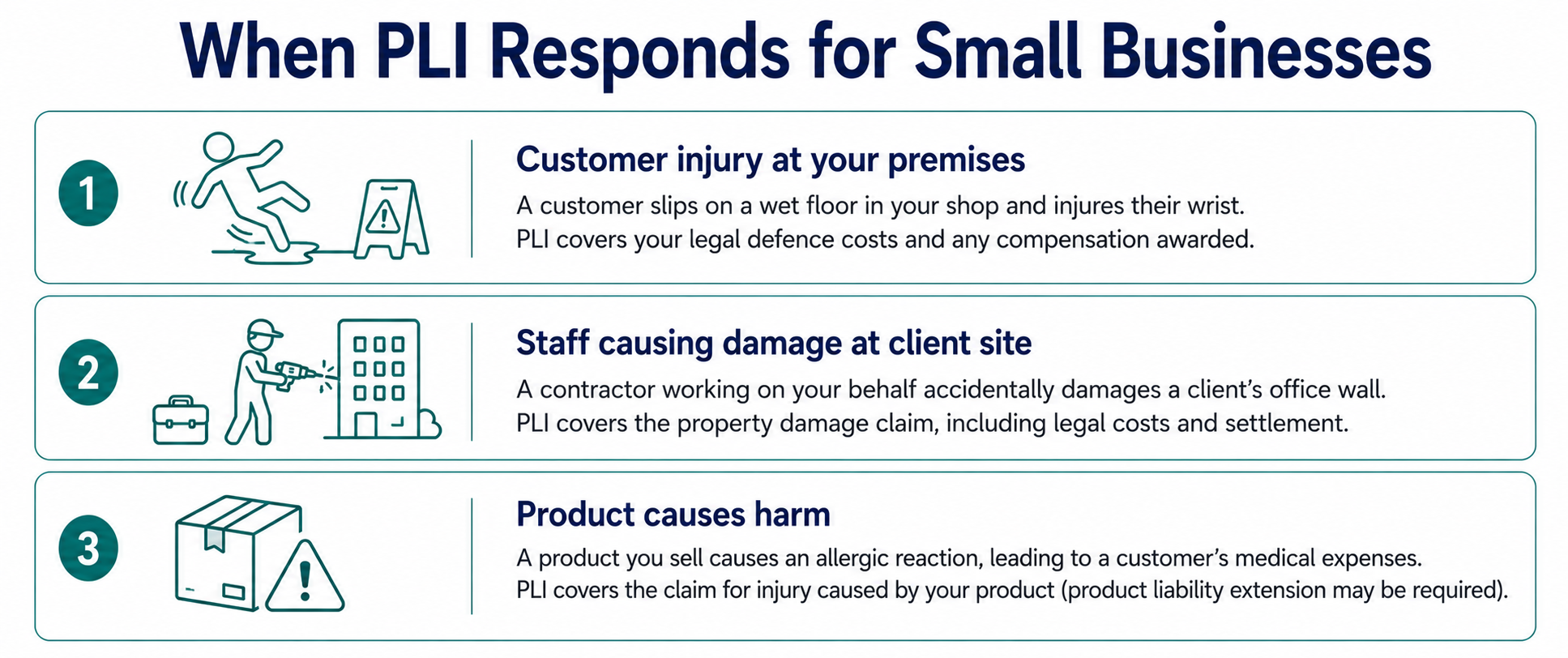
Scenario A, Customer or Visitor Injury at Your Premises
Any small business that operates from a physical location and receives customers, clients, or visitors has the most straightforward PLI exposure. A customer slips on a wet floor. A delivery driver trips on an uneven step. A visitor to a showroom catches their coat on an exposed fixture and falls.
The liability test: You are liable when the incident arises from a condition of your premises or your activities that you knew about (or should have known about) and failed to address. A wet floor without a warning sign is the textbook example. A loose tile you had been meaning to fix is another.
Coverage requirement: Retail, hospitality, and service businesses with public premises should hold a minimum of £2m PLI. Most commercial landlords and leases require this as a minimum condition of occupancy.
Scenario B, Staff or Contractor Working at Third-Party Locations
Small businesses that send employees or contractors to work at client premises, cleaning companies, IT support firms, maintenance contractors, delivery businesses, event companies, have PLI exposure at every site visit.
A cleaner who accidentally knocks over and breaks a client's server rack. An IT engineer who trips over a cable they placed and falls into a client's display case. A maintenance contractor who damages a water pipe while working in a client's ceiling void.
The critical distinction: Staff injury at client premises is covered by employers liability insurance, not PLI. The PLI claim here is when your staff causes damage or injury to the client's property or a third party at the site, not when your own staff member is hurt.
Scenario C, Products or Services Causing Third-Party Loss
Small businesses that supply products, manufacturers, retailers, importers, caterers, face PLI claims when their products cause physical harm. A batch of food that causes an allergic reaction. A product that malfunctions and causes a fire. A tool that fails during use and causes an injury.
Important: Product liability claims are technically separate from standard PLI in strict policy terms. Many combined small business PLI policies include product liability as a bundled extension, check your specific policy for whether "products liability" or "goods supplied" is included or requires a separate addition.
Choosing Your Coverage Level, the Decision Framework for SMEs
Start With Your Contractual Minimums
Pull every active client contract and every active or pending framework agreement. Search for the words "insurance," "liability," and "indemnity." The highest minimum across all contracts is your coverage floor.
Common contractual minimums by client type:
| Client / Framework Type | Typical Minimum PLI Required |
|---|---|
| Standard commercial client (SME) | £1m–£2m |
| Corporate client (FTSE 500 supplier agreement) | £5m |
| Government / Crown Commercial Service | £5m–£10m |
| NHS supply chain | £5m |
| Local authority | £2m–£5m |
| School or education sector | £5m |
| Construction framework (Constructionline, CHAS) | £5m |
| Venue hire agreement | £1m–£2m |
| Market / exhibition organiser | £1m–£2m |
Then Add the Risk-Based Adjustment
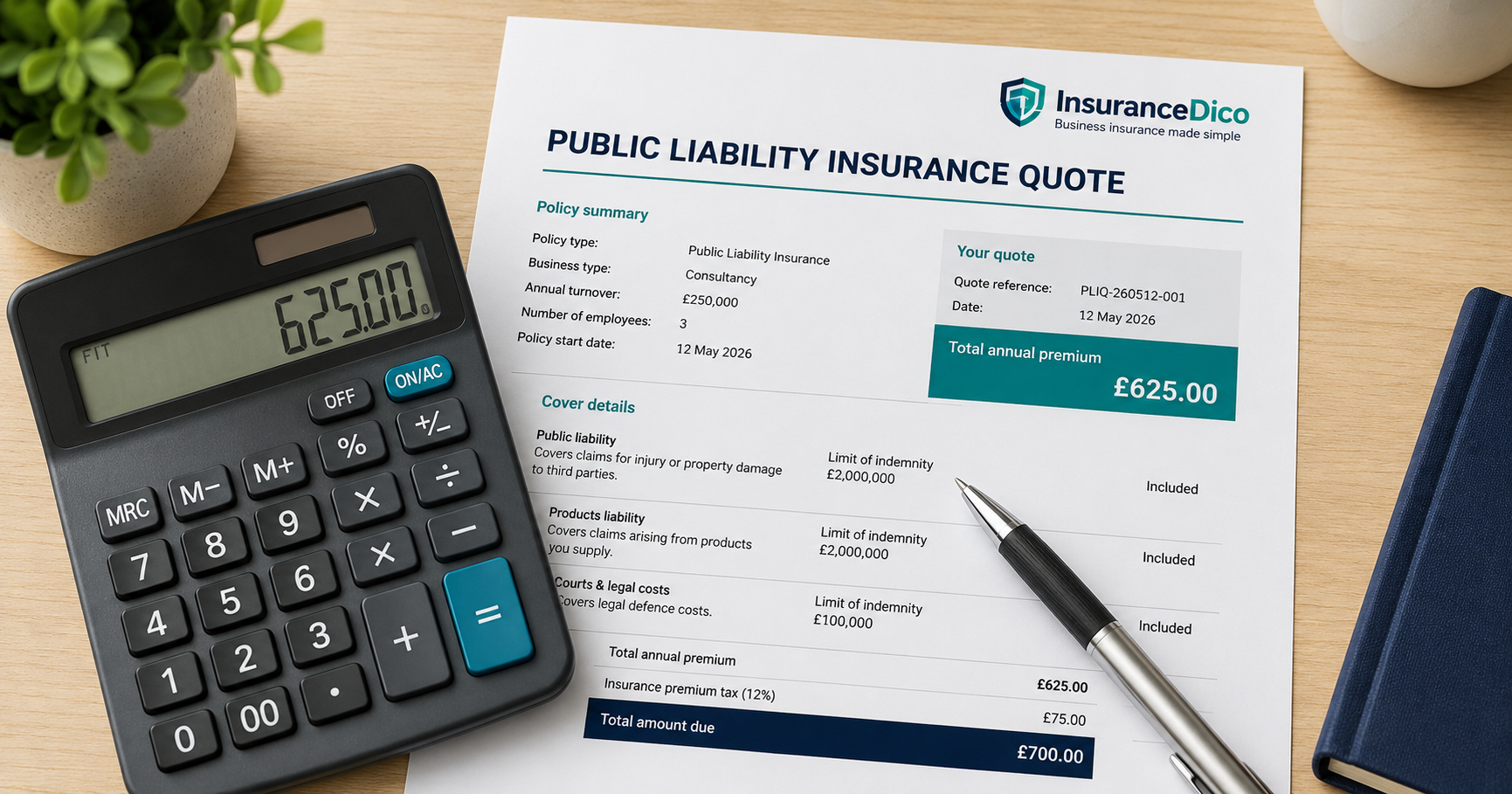
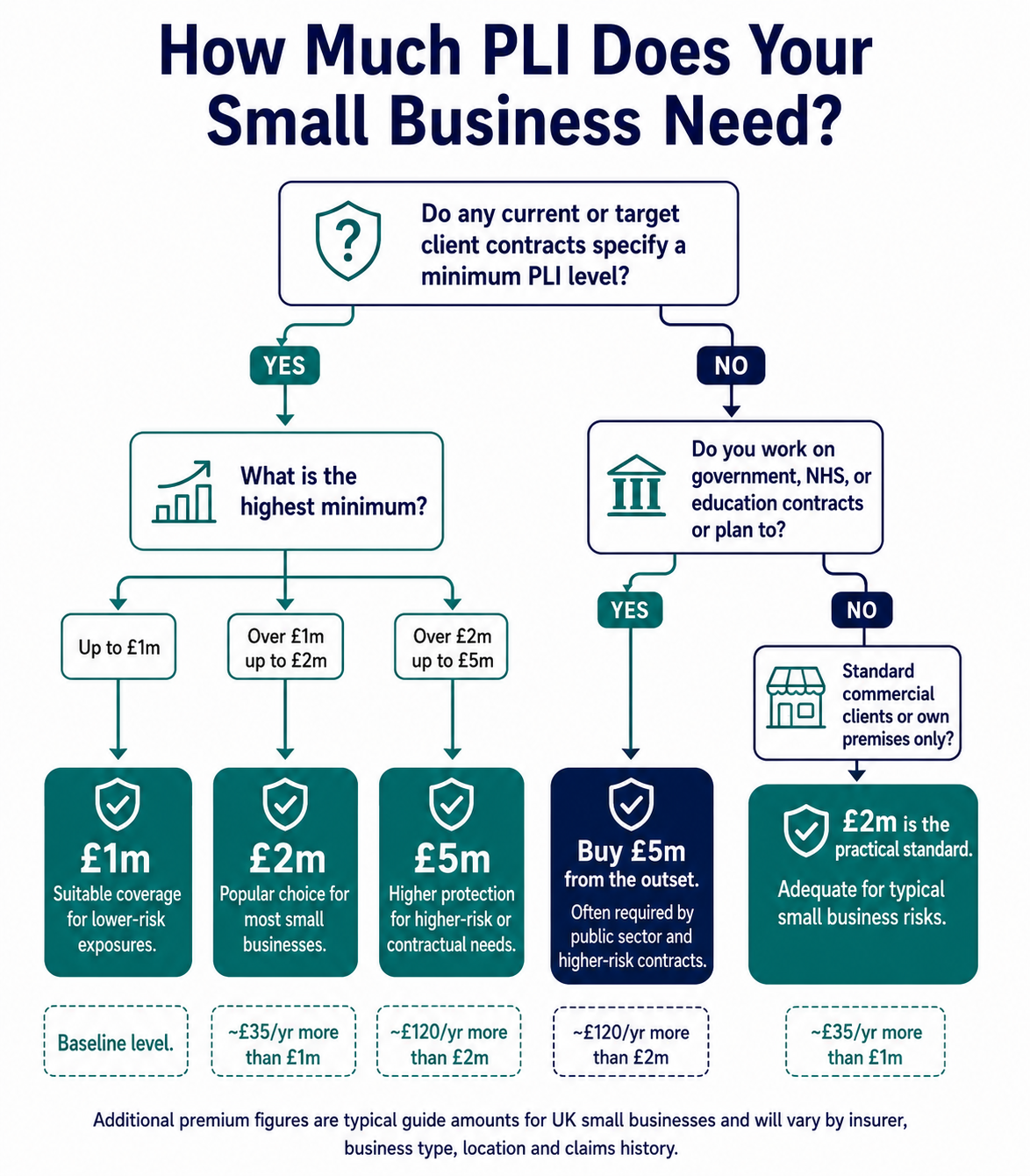
Once you know your contractual floor, assess whether your actual exposure justifies a higher level. The cost increment between levels is modest:
- £1m to £2m: typically £20–£50 additional per year
- £2m to £5m: typically £50–£120 additional per year
For most small businesses, the cost of moving from £1m to £5m is under £150 per year, and eliminates the need to hold a different policy for different clients.
The practical recommendation: for any small business pursuing a mix of standard commercial and public sector work, £5m PLI at the outset is a more cost-efficient approach than £2m now and having to upgrade when a government contract opportunity arrives.
2026 PLI Premiums for Small Businesses, by Sector and Size
Professional Services (1–5 employees)
| Business Type | £2m Cover | £5m Cover |
|---|---|---|
| IT consultancy | £125–£215 | £175–£295 |
| Marketing agency | £135–£228 | £188–£315 |
| HR or recruitment | £140–£232 | £195–£320 |
| Management consultancy | £145–£245 | £202–£338 |
| Accounting practice | £155–£260 | £215–£358 |
Retail and Hospitality (1–5 employees)
| Business Type | £2m Cover | £5m Cover |
|---|---|---|
| Small retail shop | £150–£255 | £205–£350 |
| Café or coffee shop | £165–£280 | £228–£385 |
| Hair salon or barber | £145–£248 | £200–£342 |
| Beauty salon or spa | £158–£265 | £218–£365 |
| Independent restaurant | £180–£305 | £248–£420 |
Trade and Services (1–5 employees)
| Business Type | £2m Cover | £5m Cover |
|---|---|---|
| Cleaning company | £165–£278 | £228–£382 |
| Landscaping / grounds maintenance | £175–£295 | £240–£405 |
| Property maintenance | £190–£318 | £262–£438 |
| Electrical contractor | £215–£358 | £295–£492 |
| Plumbing and heating | £205–£345 | £282–£475 |
Source: InsuranceDico 2026 market analysis. Assumes no claims in past 5 years and standard activities as described.
The Four Most Costly PLI Mistakes Small Businesses Make
Mistake 1, Buying the Cheapest Available Without Reading Exclusions
Budget PLI policies achieve their lower premium through more restrictive activity definitions and exclusions. A cleaning company policy priced at £80 for £1m coverage may exclude claims arising from work above ground floor level, claims involving subcontractors, or claims arising from the use of specific cleaning chemicals. A claim that falls into any exclusion is an uninsured claim, the policy provides no protection.
Always read the exclusions section before purchasing. The features page and price comparison table do not describe the exclusions.
Mistake 2, Not Updating When the Business Grows
A business with two staff that grows to eight staff has materially increased its PLI exposure, eight people creating potential third-party incidents rather than two. Most PLI policies require notification of significant headcount changes. A policy priced for two employees is technically underwritten for two employees. A major claim arising during a period when the business had eight employees but declared two will be investigated for material non-disclosure.
Review your PLI at every annual renewal to ensure the declared headcount, turnover, and activities match your current business, not what the business was when you first took out the policy.
Mistake 3, Assuming PLI Covers Everything Business-Related
PLI covers third-party physical harm and property damage. It does not cover: professional errors (PI insurance), employee injury (employers liability), your own equipment (business contents insurance), or financial loss from your advice or services (PI insurance). Many small business owners discover a significant coverage gap when they assume their PLI handles a claim that actually requires a product they do not hold.
Mistake 4, Letting PLI Lapse Between Policy Years
Even a single day without PLI, during a renewal gap or a payment failure, is a period of uninsured operation. If an incident occurs during a lapsed period, the claim is entirely uninsured. Set up direct debit annual payments or calendar renewals 30 days before expiry. Check that your policy certificate shows the correct renewal date and that the new certificate is received before the old one expires.
⚠️ Warning: The Claims and Underwriting Exchange (CUE) database records all insurance claims against a business address and business name, not only against the named policyholder. When you renew or switch PLI insurer, the new insurer checks CUE for prior claims history. A claim made during a previous occupier's tenancy at the same premises may appear in your CUE check. Always disclose what you know; if a prior occupier's claim appears and you were not the responsible party, this can be addressed with the insurer at application.
Bottom Line for UK Small Businesses
One in five UK SMEs has faced a public liability claim in the past five years according to ABI data. The average cost of defending a commercial liability claim, before any compensation, exceeded £13,500 in 2023, a figure that represents months of operating profit for most businesses with fewer than 10 employees.
For most UK small businesses, £2m PLI is the practical standard and £5m the safer floor if you intend to bid for corporate, NHS, local authority or framework work. The incremental cost, typically under £150 per year, is negligible relative to the protection provided and the procurement doors it opens. Bundle PLI with employers liability and professional indemnity where possible to cut administration and 15–25% off the combined premium.