
Home insurance in the UK covers two distinct risks — the structure of your property (buildings insurance) and the possessions inside it (contents insurance). Buildings insurance is required by virtually every mortgage lender. Contents insurance is optional but recommended. A combined policy on a standard three-bedroom semi-detached home typically costs £140–£240 per year. The most significant risk most homeowners face is underinsurance — research shows over 70% of UK properties are insured below their true rebuild cost.
Home insurance UK is a composite product that combines buildings insurance — covering the permanent structure of a property — with contents insurance, covering possessions inside it, regulated by the Financial Conduct Authority and required by mortgage lenders as a condition of lending.
Buildings vs contents insurance: the distinction that catches most homeowners out
The single most common source of confusion in UK home insurance is the boundary between what buildings insurance covers and what contents insurance covers. Getting it wrong leads to either a gap in coverage or paying for duplicate protection.
Buildings insurance covers the permanent structure of your home and anything fixed to it — the walls, roof, floors, ceilings and foundations; permanently fitted kitchens and bathrooms; built-in wardrobes, fireplaces and fitted flooring; garages, sheds and outbuildings in the grounds; and fixed domestic installations such as the boiler, pipes, wiring and solar panels.
Contents insurance covers everything you could physically move out of the property if you sold it: furniture, soft furnishings and appliances; clothing, jewellery and personal items; electronics such as TVs, laptops and tablets; freestanding kitchen appliances; bicycles and sports equipment (subject to limits); and money and credit cards up to defined sub-limits.
Leaseholders vs freeholders. If you own a leasehold flat, the freeholder is typically responsible for buildings insurance covering the structure — and you pay a share of the cost through your service charge. You are responsible for your own contents insurance. Always check your lease terms, because in some arrangements the leaseholder must arrange buildings insurance for the interior structure themselves.
The underinsurance crisis — why over 70% of UK homes are exposed
Research published by Zurich Insurance found that more than 70% of UK residential properties are underinsured — coverage is insufficient to fund a full rebuild or contents replacement. The average underinsured property carries coverage at only 67% of its true rebuild value.
Buildings underinsurance: rebuild cost vs market value
Market value is what you paid for your home, or what it would sell for today, including the land. Rebuild cost is the cost of demolishing the existing structure and rebuilding it from scratch — labour, materials, architect fees, planning permissions and site clearance — and excludes land value entirely. The two figures are frequently very different.
| Property type | Typical market value | Typical rebuild cost | Notes |
|---|---|---|---|
| 2-bed terraced, North of England | £140,000 | £160,000 – £190,000 | Rebuild exceeds market value |
| 3-bed semi, Midlands | £220,000 | £185,000 – £220,000 | Broadly similar |
| 3-bed detached, South-East | £480,000 | £230,000 – £280,000 | Market value significantly higher |
| Victorian townhouse, London | £950,000 | £450,000 – £650,000 | Market value much higher |
| Listed period property | varies | +30–80% vs standard | Period materials and approved contractors |
The Building Cost Information Service (BCIS) — part of the Royal Institution of Chartered Surveyors (RICS) — publishes a residential rebuild cost calculator accessible through the Association of British Insurers website. It takes around five minutes and should be the basis for your buildings sum insured. For listed buildings, thatched roofs, stone or flint walls, or properties over 150 years old, a professional RICS-accredited rebuild survey is strongly recommended.
Contents underinsurance: the 40% gap
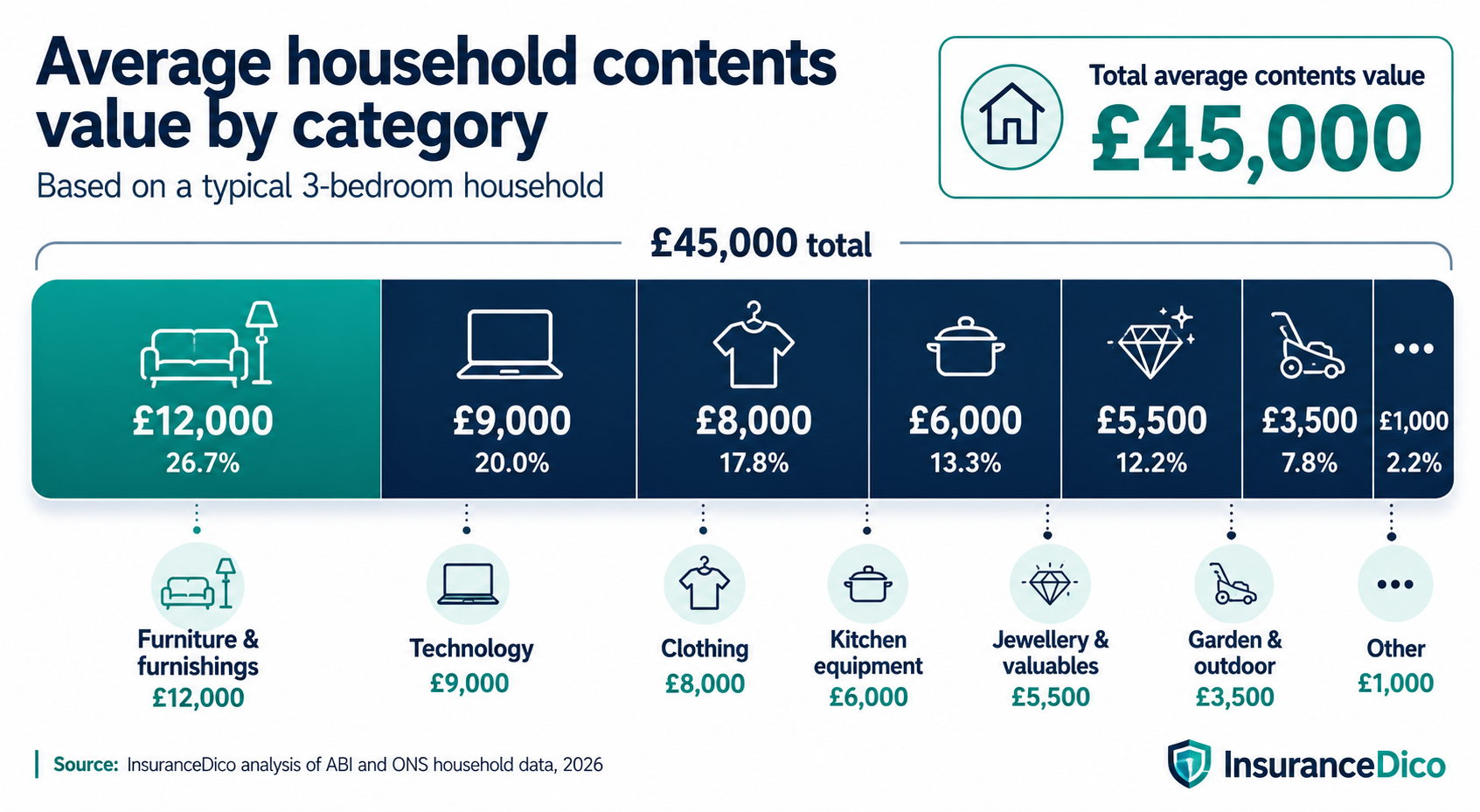
Research from the Building Societies Association found that the average UK household underestimates the value of their contents by approximately 40%. The most commonly undervalued categories are clothing (most people estimate £2–3k against an actual replacement cost of £6–15k); jewellery (engagement rings, inherited pieces, accumulated gifts routinely omitted); technology (a household with two adults and two teenagers may have £8–14k in devices); and garden contents and tools (mower, garden furniture, shed contents often forgotten entirely).
What home insurance covers — and the exclusions most buyers discover at claim
Most standard UK home insurance policies cover loss or damage caused by fire, explosion and smoke; storm and flood (subject to the property's flood-risk status); escape of water from burst pipes, leaking appliances or overflowing tanks; subsidence and ground heave; theft and attempted theft; vandalism and malicious damage; impact damage from vehicles, falling trees or aircraft; and riot or civil commotion.
The accidental damage gap. Standard home insurance covers named perils — specific events listed in the policy. Accidental damage (dropping the TV, spilling wine on the sofa, a child putting a ball through a window) is generally not covered unless you add the optional extension, typically £25–£60 a year. The escape-of-water distinction. Escape of water is a covered event — but the insurer pays for the damage caused by the water, not the cost of repairing the pipe or appliance that caused the leak.
How much does home insurance cost in 2026?
Home insurance premiums are among the most variable in the UK market — two identical properties in different postcodes can have premiums differing by 40% or more. Property-specific factors include age, construction type and rebuild cost, postcode (flood, subsidence and crime), claims history at the address, and security features. Policyholder-specific factors include personal claims history (typically 5 years), whether the property is a main residence, and occupation.
| Property type | Buildings only | Contents only | Combined |
|---|---|---|---|
| 1-bed flat (leasehold) | n/a — via freeholder | £70 – £130 | n/a |
| 2-bed terraced | £120 – £185 | £90 – £145 | £170 – £290 |
| 3-bed semi-detached | £145 – £215 | £100 – £165 | £195 – £340 |
| 3-bed detached | £165 – £260 | £115 – £190 | £240 – £400 |
| 4-bed detached | £190 – £320 | £130 – £220 | £280 – £490 |
| Listed building | £280 – £800 | £140 – £280 | £400 – £1,000+ |
How to reduce your premium without reducing your cover
- Increase your voluntary excess to £500 — typically cuts premiums 10–20%. Only choose a level your emergency savings can absorb.
- Install certified security — five-lever BS3621 deadlocks, BS-rated window locks and a monitored alarm reduce premiums 5–15%.
- Pay annually, not monthly. Monthly instalments carry an implicit 15–25% APR.
- Build a claims-free history. Avoid small claims close to your excess — a £400 claim with a £250 excess nets £150 but can cost far more in renewals over three to five years.
- Insure for accurate rebuild cost — over-insuring wastes premium on coverage you can't claim.
The four types of UK home insurance and who needs each
1. Standard buildings and contents — homeowners. The default for owner-occupiers. Combined policies typically offer a 10–20% discount versus separate ones. Confirm new-for-old (replace at today's prices) rather than indemnity (depreciated payout) — new-for-old is standard on mid-tier and above policies.
2. Landlord insurance — buy-to-let and rental properties. Standard home insurance excludes tenanted properties. Landlord policies add property owners' liability (the single most important element — without it a tenant's injury claim is uninsured), loss of rental income, malicious damage by tenants and legal expenses for eviction and rent recovery.
3. Contents-only insurance — renters and tenants. Your landlord's insurance does not cover your belongings. A fire that destroys the building rebuilds the structure — your clothes, electronics and furniture are your responsibility. Renters' contents cover costs £70–£130 per year for most properties. A personal possessions extension is required to cover items outside the home (phones, laptops, jewellery).
4. High-value and specialist home insurance — non-standard properties. Standard policies are designed for brick or stone construction with contents below £75–£100k. Beyond that you need specialist underwriters (Hiscox, Chubb, AIG Private Client), specialist listed-building cover (Planning (Listed Buildings) Act 1990 rebuild requirements), thatched-property cover (50–200% surcharges) or non-standard-construction underwriting (timber-frame, PRC, steel-frame and pre-1900 builds).
Flood risk and home insurance in 2026
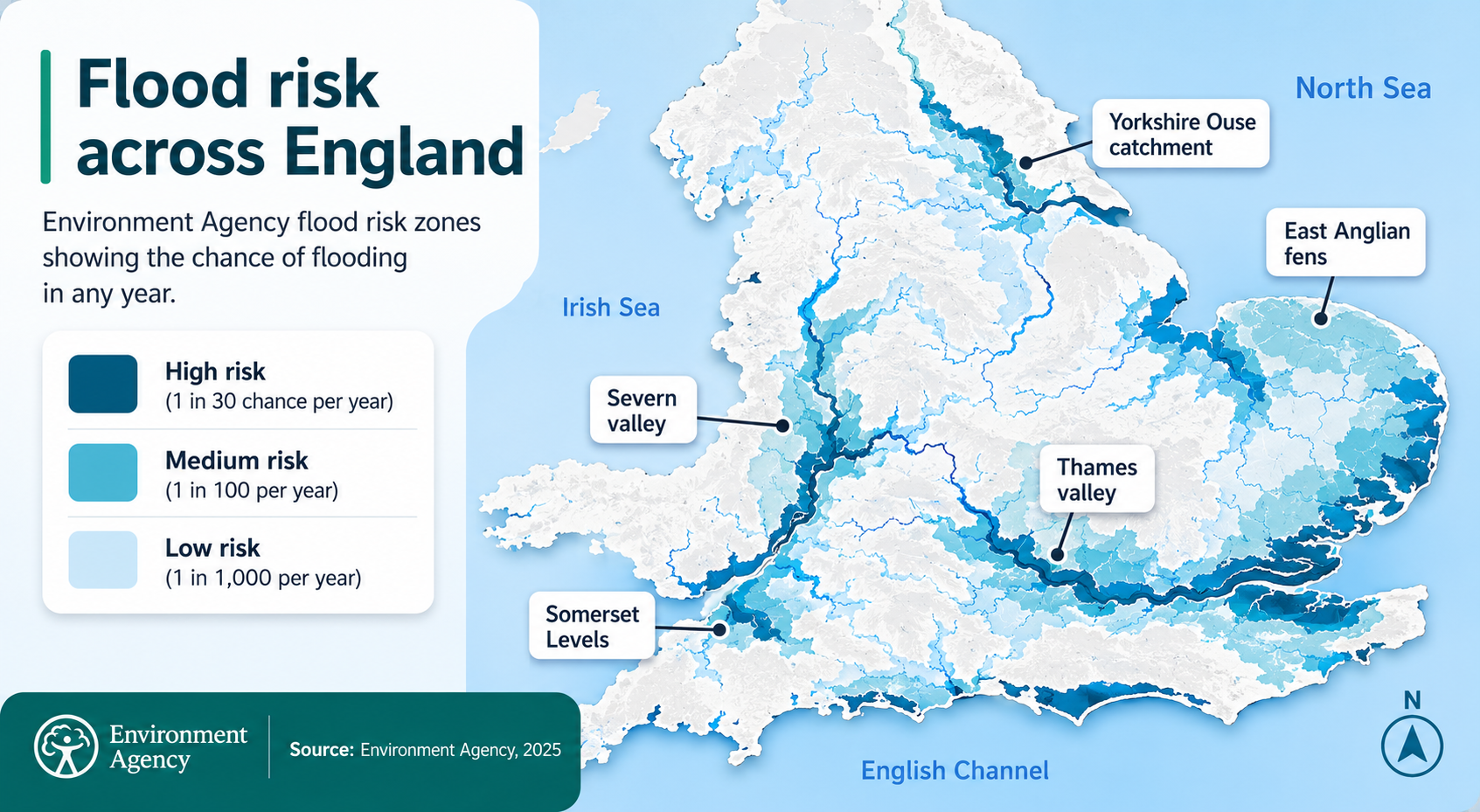
The Environment Agency estimates that 5.2 million properties in England are at some risk of flooding — from rivers, the sea or surface water. For properties in high-risk zones, home insurance was historically either unavailable or prohibitively expensive. Flood Re changed that for most eligible properties.
How to choose home insurance that actually pays when you claim
- Confirm your sum insured is accurate before buying. Use the BCIS rebuild calculator for buildings. Walk every room for contents using today's replacement prices.
- Read the exclusions, not the features page. The exclusions determine whether your specific claim is paid. Fifteen minutes on the exclusions before purchase prevents most disputes.
- Check whether accidental damage is included or an add-on. It's optional on most policies. Worth £25–£60 a year if you have children, pets or fragile valuables.
- Verify single-item limits. Most contents policies cap individual items at £1,500–£2,500 without specific declaration. A £4,000 engagement ring is underinsured at standard limits.
- Confirm new-for-old, not indemnity. Indemnity on a five-year-old laptop might pay £80 toward a £900 replacement.
- Check the escape-of-water excess separately. Many policies apply a higher excess (£250–£500 above standard) specifically to escape-of-water — the single most-claimed event.
| Entity | Attribute | Value | Source |
|---|---|---|---|
| Buildings sum insured | calculation basis | Rebuild cost (BCIS) — not market value or purchase price | RICS / BCIS rebuild calculator, 2026 |
| Contents sum insured | valuation method | New-for-old replacement at today's retail prices, room-by-room | ABI valuation guidance, 2024 |
| Accidental damage | default status | Optional extension on standard policies (£25–£60/yr) | Consumer Intelligence UK Home Survey, 2025 |
| Escape of water | policy excess | Often higher than standard excess by £250–£500 | InsuranceDico policy wording review, 2026 |
| Flood Re eligibility | build date cut-off | Residential properties built before January 2009 | Flood Re scheme rules, Water Act 2014 |
“The gap between what home insurance appears to offer at point of sale and what it actually delivers at point of claim is one of the most documented frustrations in UK personal insurance — and almost all of it comes down to exclusions read for the first time after a loss.”
Key takeaways
- Home insurance UK combines buildings and contents cover; mortgage lenders require buildings, contents is optional.
- Home insurance UK rebuild cost — not market value — sets the buildings sum insured to avoid average-clause settlement cuts.
- Home insurance UK in flood zones is made affordable for pre-2009 properties via the Flood Re reinsurance scheme.