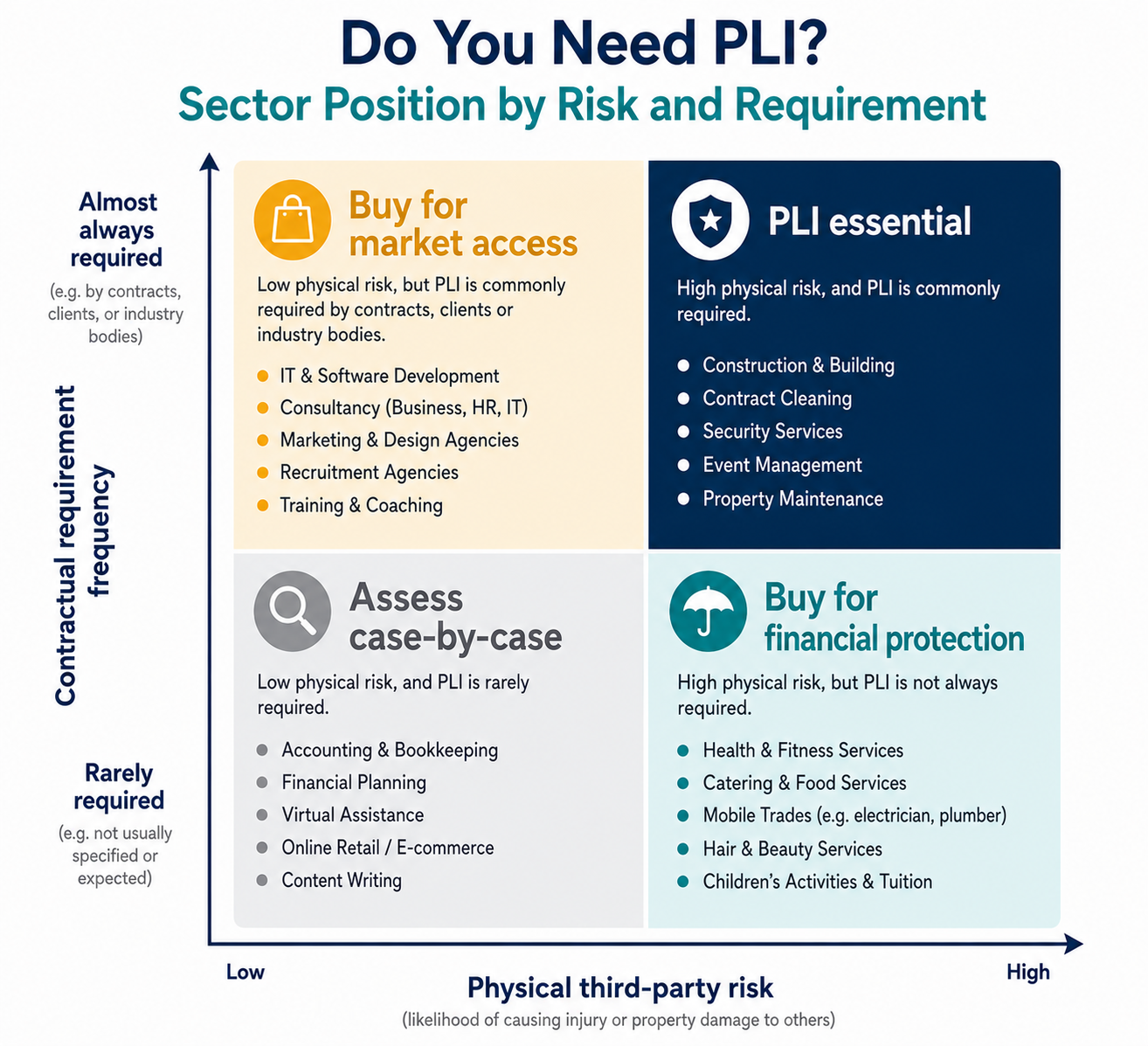
The most common source of confusion when researching PLI is the relationship between what is legally required and what is effectively unavoidable. For the vast majority of UK businesses, public liability insurance is not mandated by statute, yet the moment you sign a commercial contract, hire a venue, or join a trade accreditation scheme, it becomes the price of doing business. The real question is not whether the law forces you to buy PLI, but whether you can operate commercially without it.
The Legal Position, What UK Law Actually Requires
Public liability insurance is NOT legally required for most UK businesses. There is no single piece of UK legislation that mandates PLI across the general business population. This is the correct and complete legal position.
Employers liability insurance IS legally required, this is the product most commonly confused with PLI. The Employers Liability (Compulsory Insurance) Act 1969 requires every UK business with one or more employees to hold a minimum of £5m of employers liability insurance. This covers employee injury claims, not third-party claims. It is a separate product from PLI. Holding one does not provide the other.
The exceptions, where PLI is legally mandated: A small number of regulated activities and licensed professions require PLI as a condition of operation.
| Activity / Licence | PLI Requirement | Regulatory Body |
|---|---|---|
| SIA security operatives | Required for SIA licence | Security Industry Authority |
| Gas Safe registered engineers | Required for registration | Gas Safe Register |
| Horse riding establishments | Required under legislation | Riding Establishments Act 1970 |
| NICEIC / NAPIT registered electricians | Required for scheme membership | NICEIC / NAPIT |
| Motor sports event organisers | Third-party liability required | Motor Sports Association |
For businesses not in these regulated categories, there is no legal obligation. The analysis then shifts from legal compliance to commercial necessity and financial prudence.
The Four Factors That Determine Whether You Need PLI
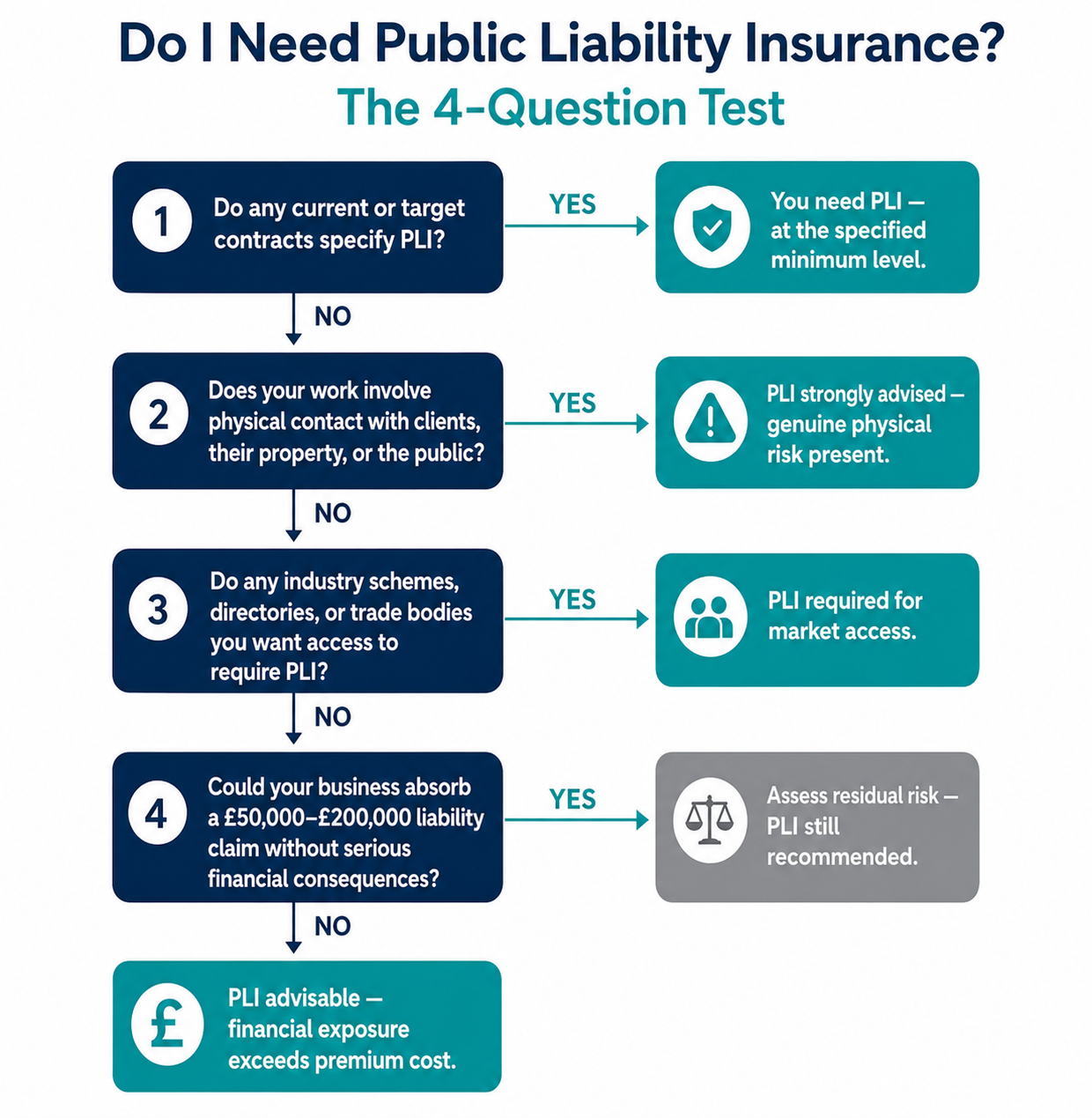
Factor 1, Do Your Contracts Require It?
The fastest and most definitive test: review every current or target client contract for an insurance clause. Most commercial contracts include a supplier insurance section specifying minimum PLI levels. The contractual landscape varies sharply by client type.
| Client / Framework Type | Typical Minimum PLI Required | Consequence of Non-Compliance |
|---|---|---|
| Standard commercial business | £1m–£2m | Breach of contract from signature date |
| Corporate client (FTSE companies) | £5m | Excluded from supplier approval |
| Government framework | £5m–£10m | Cannot tender or be awarded work |
| NHS / health sector | £5m | Excluded from procurement |
| Local authority | £2m–£5m | Excluded from procurement |
| Construction frameworks (CHAS, Constructionline) | £5m | Cannot achieve accreditation |
| Venue hire agreement | £1m–£2m | Booking declined or voided |
| Trade body membership | £1m–£2m | Cannot maintain membership |
If any current or target contract specifies a minimum PLI level, you need PLI at that level. This is the non-negotiable baseline.
Factor 2, Does Your Work Create Physical Third-Party Risk?
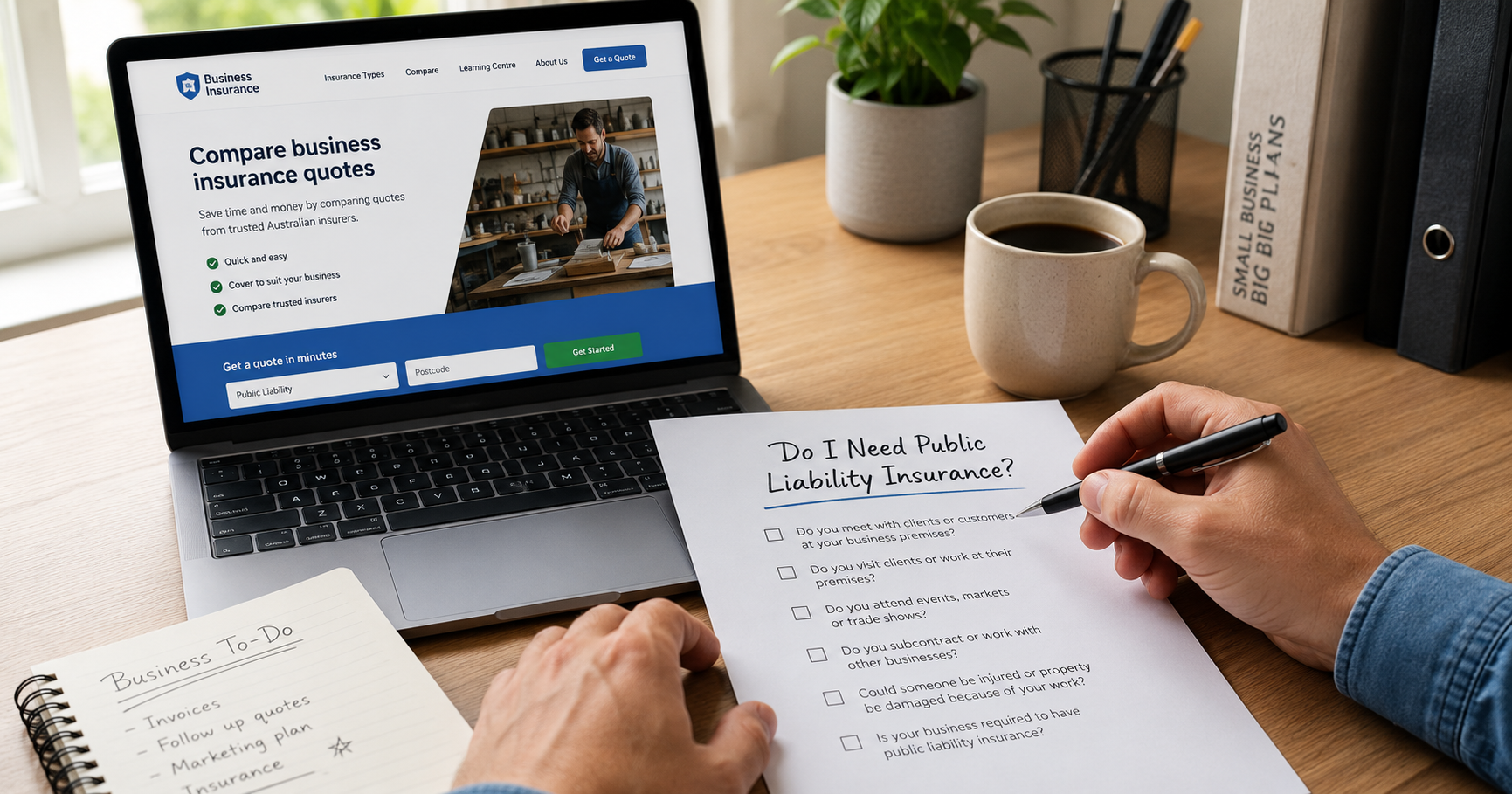
Even without a contractual obligation, genuine physical liability risk creates a sound financial case for PLI. Ask whether your work involves any of the following:
- Visiting client premises and working in their physical environment
- Having clients, customers, or the public visit your premises
- Working in public spaces, markets, events, outdoor locations
- Handling client property or working on client structures
- Supervising employees or subcontractors in client-facing environments
If the answer is yes to any of these, a third-party incident is a credible possibility. The financial consequence of an uninsured £50,000 claim is severe for most small businesses, potentially business-ending for a sole trader whose personal assets are exposed.
Factor 3, Could You Self-Fund a Serious Claim?
This is the financial test. A serious personal injury claim in the UK, one involving hospitalisation, ongoing treatment, and loss of earnings, can cost £100,000–£500,000 in total damages plus £30,000–£150,000 in legal defence costs.
The relevant question is not whether such a claim is likely but whether you could absorb it if it occurred. For businesses with extensive liquid reserves and the ability to self-insure, PLI is a preference decision. For the vast majority of small businesses, including profitable ones, a six-figure liability claim is not self-fundable without material consequences.
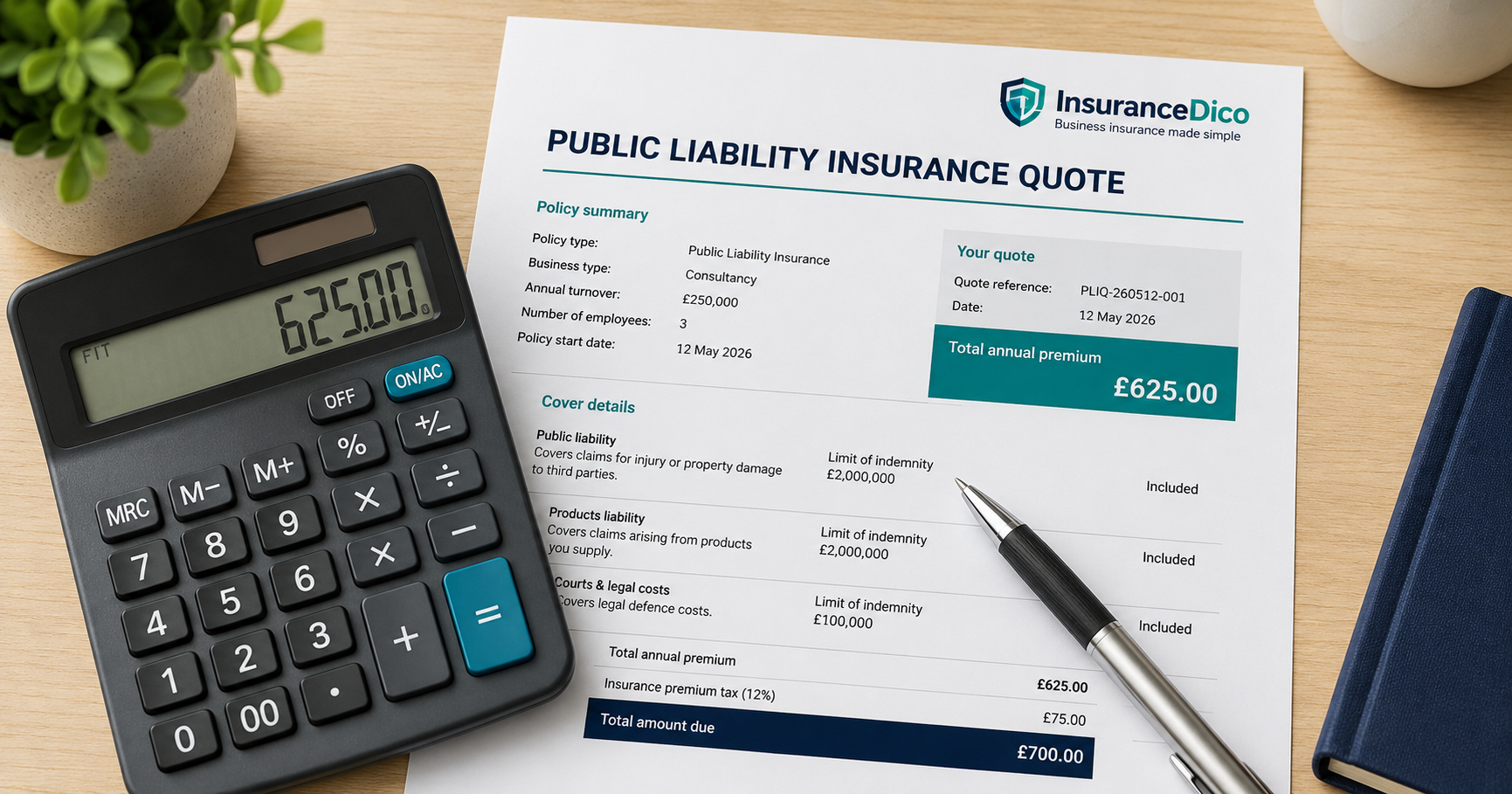
PLI at £80–£200 per year transfers this tail risk to an insurer. The expected value argument is straightforward: the probability of a major claim is low, but the severity if it occurs is high, and the premium is small relative to both.
Factor 4, Does Your Industry Require It for Market Access?
Beyond individual contracts, many industries effectively require PLI for normal market participation through accreditation schemes, directory listings, and trade body membership:
- Construction sector: Constructionline, CHAS, SafeContractor, SMAS, Altius, all require valid PLI as a membership condition
- Freelance and gig economy: Checkatrade, Bark.com, and some segments of Upwork and People Per Hour require PLI for premium listing categories
- Events and hospitality: Most venue booking platforms require a PLI certificate before confirming a booking
- Education sector: Schools, colleges, and universities require PLI from any supplier visiting their sites or providing services
Without PLI, participation in these industry channels is restricted or eliminated.
Who Does Not Need PLI, an Honest Assessment
Not every business has a genuine need for public liability insurance. The following scenarios represent genuine low-necessity situations.
Fully remote professionals with zero physical client interaction. A software developer who works exclusively from home, communicates only digitally, never visits client offices, and takes contracts through platforms that specify no PLI requirement has minimal third-party physical liability risk. The formal case for PLI is weak. The residual risk is not zero, a client who visits the home office unexpectedly, or a delivery driver who trips at the property during a business-related delivery, but it is genuinely low.
Platform-covered gig workers. Some delivery and rideshare platforms provide liability coverage to workers while actively on a platform assignment. Workers should verify whether the platform coverage extends to transit between assignments, whether it applies during all hours worked or only during confirmed assignments, and what the coverage limit is.
Businesses with back-to-back contractual protections. A business whose contracts with clients strictly limit its liability, whose clients have their own liability coverage, and whose business activities are genuinely low-risk may have a weaker case for PLI. However, contractual liability limitation and insurance are not the same thing, limiting your liability in a contract does not prevent someone from bringing a claim.
What does not eliminate the need: Working from home does not eliminate the need when clients visit for business meetings, residential home insurance does not cover business visitor injury. Being a limited company does not eliminate the need, the company is liable for its activities regardless of structure. Having professional indemnity insurance does not eliminate the need, PI covers financial harm from professional errors; PLI covers physical harm to third parties.
The Sector-by-Sector Assessment
Sectors Where PLI Is Effectively Mandatory
Construction and trades. PLI is a pre-qualification requirement for virtually all commercial work, all public sector procurement, and all major framework accreditations. No contractor operating commercially can function without it.
Retail and hospitality. Any premises-based business with public access faces both contractual requirements (commercial leases, venue insurers) and genuine physical liability risk from visitor injury. PLI is standard practice, not optional.
Events, entertainment, and catering. Every event venue, festival site, market, and exhibition organiser requires a valid PLI certificate as a condition of booking. Without it, the business cannot operate.
Healthcare and personal services. Home visits and clinic-based personal services (physiotherapy, massage, beauty, personal training) create genuine liability exposure and are frequently required by professional body membership.
Sectors Where PLI Need Requires Specific Assessment
Professional services (advisory, consulting, creative). Physical risk is low; contractual requirement is high. PLI is typically needed for market access rather than risk management. The £60–£110/year cost makes this an easy decision.
Technology (remote-only). Contractual requirements vary by client type. Domestic or startup clients rarely require it. Corporate and enterprise clients almost universally do. The decision should be made based on current and target client profile.
Education and training (remote delivery). Online-only trainers and educators face minimal PLI risk. In-person training at client sites or rented venues reintroduces both the contractual requirement (venue) and genuine risk (participants in a physical space).