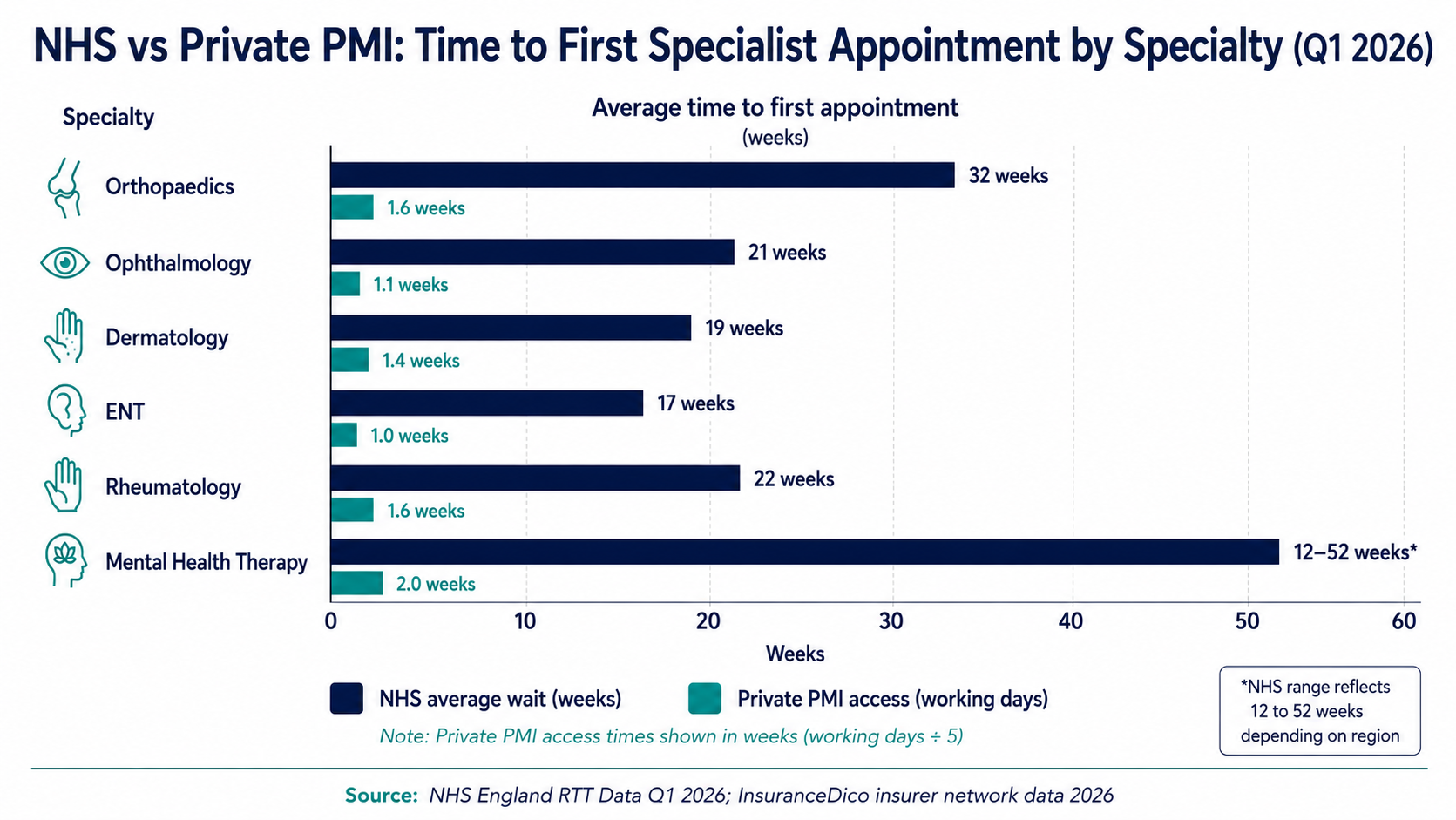
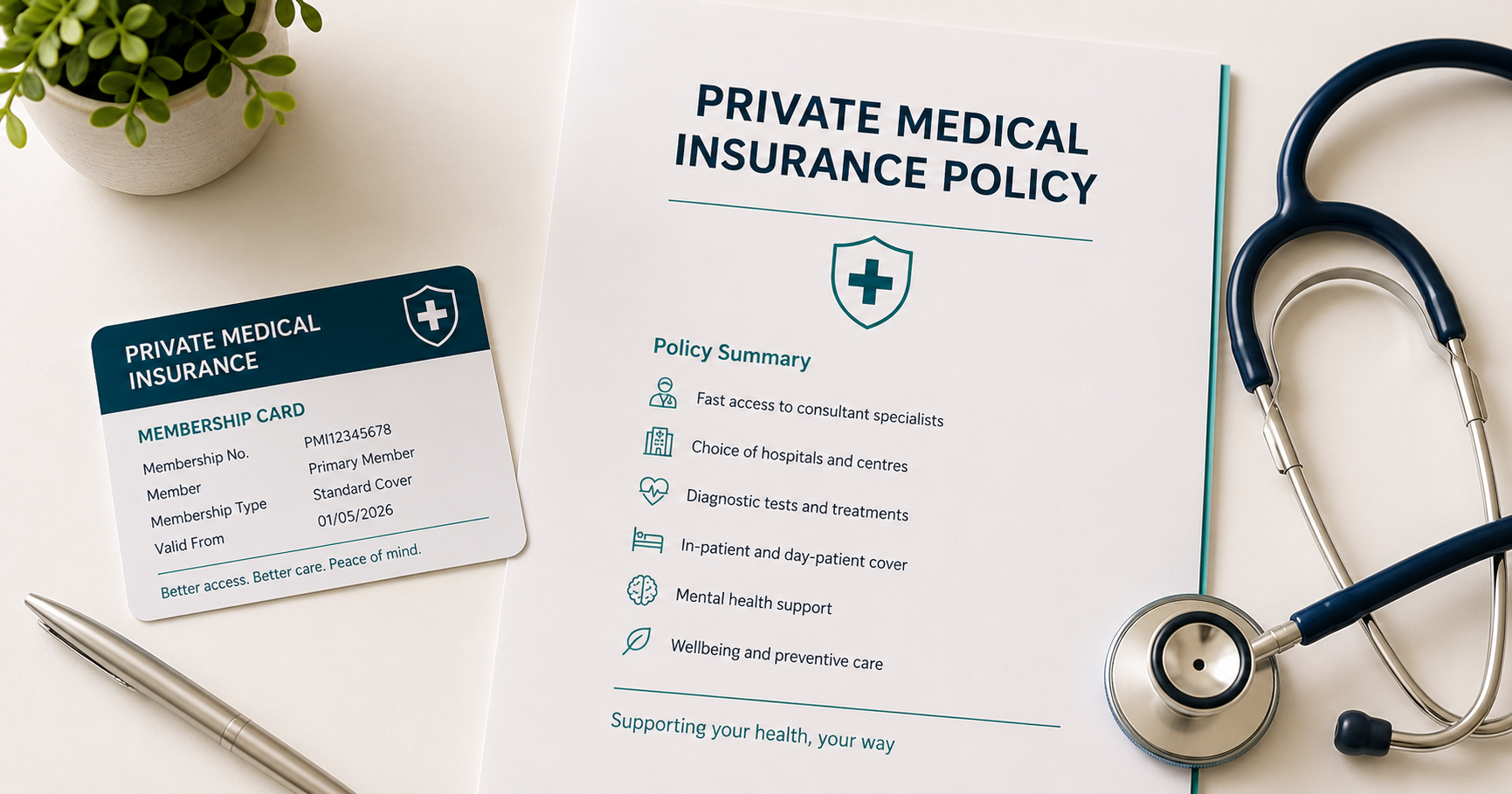
Private medical insurance covers the cost of private diagnosis and treatment for acute medical conditions — illnesses that respond to treatment, are not pre-existing, and require specialist care or surgery. In 2026, with 5.4 million people on the NHS elective waiting list and average orthopaedic waits of 32 weeks, PMI provides its strongest value for musculoskeletal, dermatological, and mental health conditions where NHS access is slowest. A standard policy for a 40-year-old costs £65–£120 per month. The most important purchasing decisions are the underwriting approach, the hospital list, and the outpatient coverage tier — not the headline premium.
Private medical insurance is a UK health protection contract that funds private diagnosis, consultation, and treatment for acute medical conditions in private hospitals and clinics, in exchange for a monthly or annual premium.
What Private Medical Insurance Covers — and the Boundaries That Matter
PMI covers the cost of private treatment for acute conditions — defined as medical problems with a defined course of treatment that are expected to improve or resolve with appropriate intervention. The boundary conditions are precise and consequential.
Covered under standard comprehensive PMI:
- Specialist outpatient consultations (consultant surgeon, physician, psychiatrist)
- Diagnostic investigations: MRI, CT, PET scans, blood panels, biopsies, endoscopy
- Inpatient surgery: elective procedures including orthopaedic (knee, hip, shoulder), hernia repair, gallbladder removal, cataract surgery, tonsillectomy
- Day-patient procedures: those not requiring an overnight stay
- Private hospital room during any admission
- Cancer diagnosis and treatment: most policies include oncology, which may extend to drugs unavailable on the NHS in your region via NICE restrictions
- Mental health: typically 28 days inpatient psychiatric care, 20–30 outpatient therapy sessions per year under comprehensive policies
Not covered under any standard PMI policy:
- A&E and emergency stabilisation — all UK PMI policyholders use NHS A&E
- Chronic condition ongoing management: diabetes medication, asthma inhalers, hypertension monitoring — PMI covers acute episodes, not long-term management
- Pre-existing conditions at inception (subject to underwriting approach)
- Maternity and obstetric care under standard policies
- Cosmetic procedures without clinical diagnosis
- Routine GP consultations (though some policies add a GP helpline)
- Dental and optical care under standard PMI (separate products)
- Organ transplants and very complex surgery are often handled by NHS specialist centres regardless of PMI status
The Three Underwriting Approaches — the Most Important PMI Decision
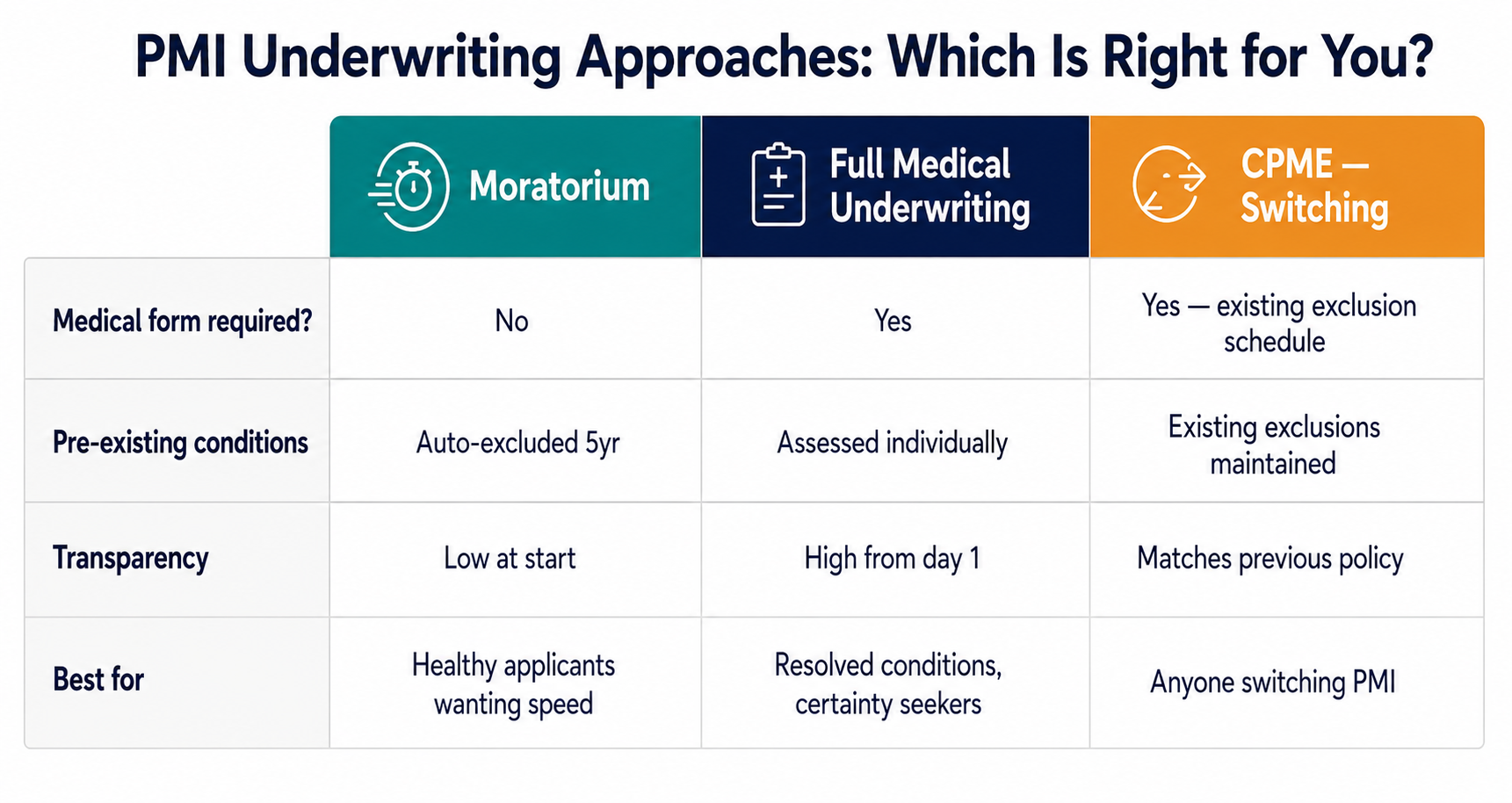
The underwriting approach determines which conditions from your medical history are excluded, and which new conditions are fully covered. This is more consequential than the premium level or the insurer brand.
Moratorium Underwriting
The default approach on most aggregator-purchased PMI policies. No medical questionnaire at application. Instead, all conditions for which you received treatment, medication, or medical advice in the five years before the policy start date are automatically excluded.
The advantage: fast and simple application. No medical form to complete. The disadvantage: you do not know your specific exclusions until you attempt to claim. A back problem treated two years ago may be excluded at the point you need it — and the exclusion is discovered during a claim, not before it.
The moratorium lift: under most moratorium policies, if you remain symptom-free and treatment-free for a condition for two consecutive years after the policy starts, that condition can be reviewed for inclusion. The two-year clock runs from the policy start date — not from your last treatment.
Full Medical Underwriting (FMU)
Requires a detailed health questionnaire at application. Each disclosed condition is assessed individually — excluded, rated, or accepted on standard terms. You receive a schedule of specific exclusions before the policy starts.
The advantage: complete transparency. You know your exclusions before any premium is paid. No claim-time surprises. The disadvantage: takes longer. Some conditions may produce exclusions that moratorium underwriting would have lifted after two symptom-free years.
Best for: applicants in good health (few or no exclusions expected), applicants with historical conditions fully resolved (the insurer may accept these on standard terms under FMU while moratorium would automatically exclude them for five years), and anyone who values certainty over simplicity.
Continued Personal Medical Exclusions (CPME)
Used when switching insurers. The new insurer accepts the exact exclusion set applied by your previous insurer, without full re-underwriting of your medical history. Conditions treated under your previous policy remain covered on the same basis.
How to Choose Your Coverage Tier — Core, Standard, or Comprehensive
Most UK PMI providers structure their products in three tiers. Understanding what each tier delivers — and what it omits — prevents the most common PMI disappointment: discovering that a claim falls outside the chosen tier's coverage.
Core / Budget PMI
Covers inpatient and day-patient surgical treatment only. No outpatient cover — meaning specialist consultations and diagnostic scans require self-funding before surgery can be arranged through PMI. In practice, this creates a significant gap: you must pay privately for the initial consultation (£150–£300) and any diagnostics (MRI: £450–£800) before reaching the point where PMI takes over.
Best for: younger, healthy individuals who want PMI protection against the cost of surgery only, and who are comfortable self-funding or using NHS for consultations and diagnostics.
Standard PMI
Adds outpatient consultant consultations and diagnostics to the core cover. This is the level at which PMI delivers its most material benefit over NHS care — the ability to see a consultant within days rather than months, and to receive diagnostic scans quickly. Mental health is typically included at limited levels.
Best for: most individuals purchasing PMI — this tier covers the journey from GP referral through diagnosis to treatment entirely within the private pathway.
Comprehensive PMI
Full outpatient coverage including physiotherapy, mental health at higher limits, therapies, and in some cases GP video consultation access and optical/dental riders. The most expensive tier, typically 40–60% above standard pricing.
Best for: individuals with a high likelihood of musculoskeletal claims (active individuals, physically demanding occupations), those prioritising mental health coverage, and families where comprehensive cover across multiple family members reduces the overall marginal cost.
The Hospital List Decision — Where the Real Premium Saving Lies
Every PMI insurer publishes one or more hospital networks. The hospital list determines which private hospitals and clinics your treatment can be arranged at under the policy.
- Open list policies: access to any private hospital in the UK in the insurer's network — typically 500+ hospitals and clinics. The most flexible and most expensive option.
- Extended list policies: a large but curated network — typically 300–400 hospitals. Most major private hospitals are included; some smaller or regional clinics may not be.
- Limited / guided list policies: a restricted network of hospitals — often the most cost-effective private facilities in the insurer's portfolio. Premium saving versus open list: typically 20–40%.
The buying decision: before choosing a hospital list tier, check whether your preferred local private hospital (or the nearest major private hospital) is on the limited list. If it is, there is no practical reason to pay for a more expansive list. The 20–40% premium saving on a limited list policy is meaningful if the hospital you would actually attend is already included.
2026 Premium Data — What PMI Actually Costs
The following table reflects standard-tier individual policies with a £250 excess and a standard hospital list. Premiums increase at each annual renewal — UK medical inflation ran at 12–18% annually between 2023 and 2025 (Mercer UK Health & Benefits Survey).
| Age | Bupa / AXA Health (indicative) | Vitality / Freedom Health | WPA / Smaller Providers |
|---|---|---|---|
| 25–29 | £48–£68 | £42–£62 | £38–£58 |
| 30–39 | £65–£95 | £58–£85 | £52–£78 |
| 40–49 | £98–£148 | £88–£132 | £80–£122 |
| 50–59 | £155–£235 | £140–£210 | £125–£192 |
| 60–69 | £238–£360 | £212–£322 | £192–£295 |
Five Legitimate Ways to Reduce Your PMI Premium
1. Increase your annual excess — from £100 to £500 typically saves 10–15%; from £100 to £1,000 saves 20–30%. Choose an excess you can absorb from savings.
2. Reduce outpatient coverage — dropping from full outpatient to a £1,000 per year outpatient limit saves 20–30% while maintaining inpatient cover.
3. Choose a limited hospital list — if your preferred hospital is on it, the 20–40% saving is cost-free.
4. Access group cover through your employer — group PMI is 20–40% cheaper per person than individual cover for equivalent benefits, because risk pools and acquisition costs are lower.
5. Use a specialist PMI broker — the main insurer comparison sites access only the large branded providers. Independent specialist PMI brokers access WPA, Freedom Health, Exeter Family Friendly, and other providers that may offer better terms for specific age groups or health profiles.
NHS vs Private PMI — Time to First Specialist Appointment
The clearest case for PMI is the gap between NHS waiting times and private access times for the same specialties. As of Q1 2026, the average NHS wait for a first orthopaedic outpatient appointment in England was 32 weeks; the equivalent private PMI access time through the insurer's specialist network is 5–10 working days.